Sixty-four stones, and not one of them is a number we made up. This page states the standard that governs each material, what the standard requires, and where the actual value for your slab has to come from — the test certificate that ships with the block.
A published property table is a catalogue average. A test certificate is your material.
Natural stone varies by block, by quarry bench, by season. Any supplier who publishes one absorption figure for a stone name is telling you about a sample they once tested, not about the slabs on your job. We publish the specification and the required minimum — then pull the certificate for the specific lot, before you write it into a schedule.
How to specify
Six things to settle before the drawing is fixed.
The technical tables below say what a stone is. These six pages say how to buy it: the match, the grade, what is on a shelf and what is not, how a code reads, and what happens between your elevation and the saw.
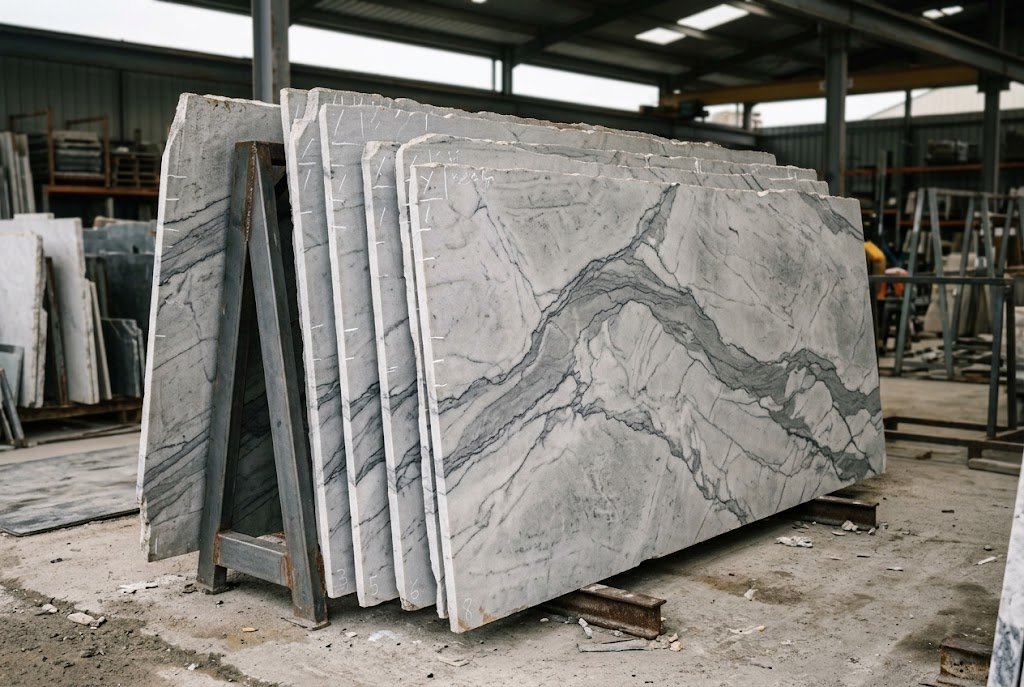
A block of marble is sawn into slabs the way a loaf is sliced. Each slab is a section through the same vein, a few millimetres further along. Slab 3 and slab 4 are nearly the same picture; slab 3 and slab 30 are two different stones. That sequence is the whole value of a matched wall — and it survives exactly one thing: being kept in order. So we number slabs at the saw, photograph them in order, and reserve them as a set.
SEQUENCED SLABS ON THE A-FRAME · VISUALIZATION
Book match
Alternate slabs are flipped face-to-back, so every joint mirrors — a butterfly across the seam. Needs consecutive slabs, minimum two; the mirror only reads if the joint is tight. Standard for a feature wall, a fireplace, a vanity front.
Slip match
Consecutive slabs laid in cut order without flipping. The vein travels one way across the whole run instead of mirroring; it reads as continuous stone rather than pattern. Use it where a book match would look staged, and on strongly directional material.
Running match
Slabs in cut order, joints falling where they fall. No balancing, no symmetry. The most economical option and the right one for large floors, where the eye reads material rather than composition.
Balance match
Slabs cut to equal width so the run is symmetrical about its own centre, with a full slab at each end rather than a sliver. Costs yield. Worth it on anything with a visible start and finish.
Centre-balance match
An even number of equal slabs centred on a joint rather than on a slab. Used when a centreline in the room — a door, an axis, a mirror — has to land on the seam.
Quarter match
Four slabs mirrored about a centre point, horizontally and vertically. A radiating figure. Used for table tops, floor medallions and single large panels. Consumes four consecutive slabs to produce one panel.
Two joins that are not matches
Cascade (waterfall) — the vein continues over an edge, horizontal to vertical, on an island or bench end. Cut from one slab, mitred at the corner. Specify which end cascades.
End match — the vein continues vertically from one panel up into the next, for walls taller than a single slab. Needs slabs consecutive in the block and a stated panel height before cutting.
How to specify it
ZS-014 · BLOCK 22 · SLABS 03–06 · BOOK MATCH · 4 SLABS · RUN 4.8 M
Material, the block it comes out of, which slabs in cut order, the match, how many, the finished run length. If you do not know the block, leave it out and we assign one — the normal case on a first enquiry.
Send only an elevation and we read the run off it and come back with the match we would use and the block that can serve it.
What comes back: numbered slab photographs of the actual lot, shot flat and in order, block and slab numbers legible in frame — and a dated reservation on that lot.
The constraint worth knowing early. A block yields a finite number of slabs. A twelve-metre book-matched run needs consecutive slabs from one block and there may not be twelve. It is the single most common late surprise on a stone package, and it is avoidable: send the elevation at design development rather than at order, and we will tell you what the block can carry before the drawing is fixed. Where a run exceeds one block, the honest options are a deliberate break at a stated joint, or a different material with better yield. We will say which we would do.
02 — The grade ladder
Three grades. One word in your spec.
Every stone in the catalogue can be supplied at three levels of selection. The material is identical; what changes is how it is chosen, how much of the block is rejected to get it, and what we guarantee about consistency. Name the grade and everything below follows without restating it.
Standard
Commercially clean, current lots
Normal variation for the species, including the range of colour and vein the quarry is producing that season. No lot reservation. Fastest and least expensive. Right for floors, back-of-house, large areas where variation reads as material.
Selected
Chosen against a stated reference
A sample you approved, a photograph, or a named lot. Slabs outside that range are rejected before shipping. Some yield loss. Right for anything you have shown a client.
Reserved
One sequenced lot, held for you
A specific numbered lot from one block, photographed and held for your project alone from the day you reserve it. Book, slip, quarter and centre-balance matching exist only at this grade. Highest yield loss, longest lead time, and the only grade that can promise a wall reads as one stone.
Grade is per element, not per project. A Reserved feature wall and a Standard floor in the same package is normal, and is what most jobs should do.
03 — Stock, selected, made
What is on a shelf, and what is not.
Almost nothing in this catalogue is on a shelf. That is deliberate, and it changes how you use it.
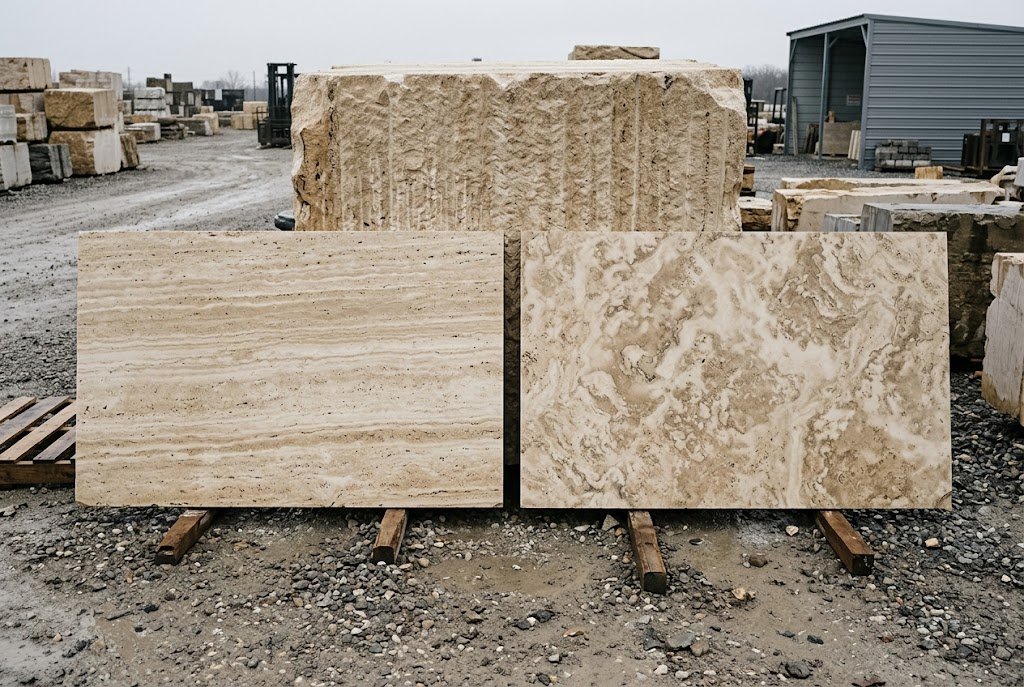
BLOCKS IN THE YARD, NOT ON A SHELF · VISUALIZATION
Held as stock
Sintered slab and porcelain
Current formats from the press line. Available in weeks, in quantity, to a published size.
Selected from current lots
Every natural stone
The material exists; the specific slabs do not become yours until you reserve them. What you are buying is a selection out of what the quarry is producing now.
Made to your drawing
All fabrication
Cut-to-size, treads, inlay, basins, counters, cladding panels. There is no model number because there is no model. The dimension comes off your elevation.
The practical consequence. A code in this catalogue is an entry point to a conversation, not a line on an order form. Send the code and the drawing together and you get a price. Send the code alone and you get a question back.
04 — Reading a ZARHA code
Every code is a sentence.
   ZS -  014  -  P  -  2  -  BM
    │     │      │     │     │
    │     │      │     │     └─  MATCH      BM book · SM slip · RM running
    │     │      │     │                    BAL balance · CB centre-balance
    │     │      │     │                    QM quarter · — none
    │     │      │     └────────  THICKNESS  cm. 1 tile · 2 slab · 3 counter
    │     │      └──────────────  FINISH     P polished · H honed · B brushed
    │     │                                  L leathered · F flamed · SB sandblasted
    │     └─────────────────────  MATERIAL   the number printed under the swatch
    └───────────────────────────  FAMILY     ZS stone · DKZ decor tile · PC porcelain
                                             CN hand-glazed çini · BN basin
ZS-014-P-2-BM is a polished 2 cm stone slab, material 014, book matched. You do not have to build the whole code: ZS-014 is enough to start and we will ask for the rest. A code with a match suffix tells us to reserve a sequenced lot, so use it only when you mean it. Codes are permanent — a material that leaves the catalogue keeps its number and the number is never reissued, so a code on a 2026 drawing still resolves in 2031.
05 — Shop drawings & submittals
What we need, what you approve.
Everything ZARHA fabricates is made to your drawing. Nothing is picked from a size chart. That means one exchange of information before anything is cut, and it is the step that protects both sides.
What you send
An elevation or plan at any scale, dimensioned. A hand markup on a PDF is enough to start.
The material code, or a description if the code is not printed here yet.
Finish, edge condition and thickness if you have a preference; we propose them if not.
For anything with a joint — a run, a wall, a counter — the joint locations, if they matter to you.
For basins: the fixture centreline, the faucet drilling and the waste position.
What we return, before fabrication
A shop drawing: plan, elevations, sections, every dimension called out, joint and seam locations marked, edge profile drawn to scale, material and finish stated per element.
Slab photographs of the actual lot where the material is matched or veined.
A landed price against that drawing, with the duty rate confirmed the week it is issued.
Approval is the gate. Shop drawings within five working days of a complete enquiry. We do not cut until a drawing comes back approved. If a dimension is wrong on the approved drawing, that is ours to fix at our cost; if it is right on the drawing and wrong on site, it is not. Fabrication starts on approval, so a drawing sitting unapproved moves the container, not the schedule. Changes are possible and free until the material is cut; after cutting, a change means new material — we will always say which side of that line a request falls on before we act.
The line we draw
Two different kinds of number, and we never mix them.
Everything on this page falls on one side or the other. If it isn't here, we don't claim it.
What ZARHA states
Published, verifiable, identical for every supplier
The ASTM specification that governs the stone type
The minimum values that specification requires
The ASTM test method behind each property
Dimensional and flatness tolerances per the NSI Dimension Stone Design Manual
Finish, edge profile, and thickness as fabricated
Crating, attic stock, and breakage policy
What the test certificate states
Lot-specific, issued by the testing laboratory
Measured absorption and bulk specific gravity (C97)
Measured compressive strength (C170)
Measured modulus of rupture (C99) and flexural strength (C880)
Measured abrasion resistance (C241 or C1353)
Measured wet or dry DCOF for the finish supplied (A326.3)
Freeze-thaw and anchorage results where the application requires them
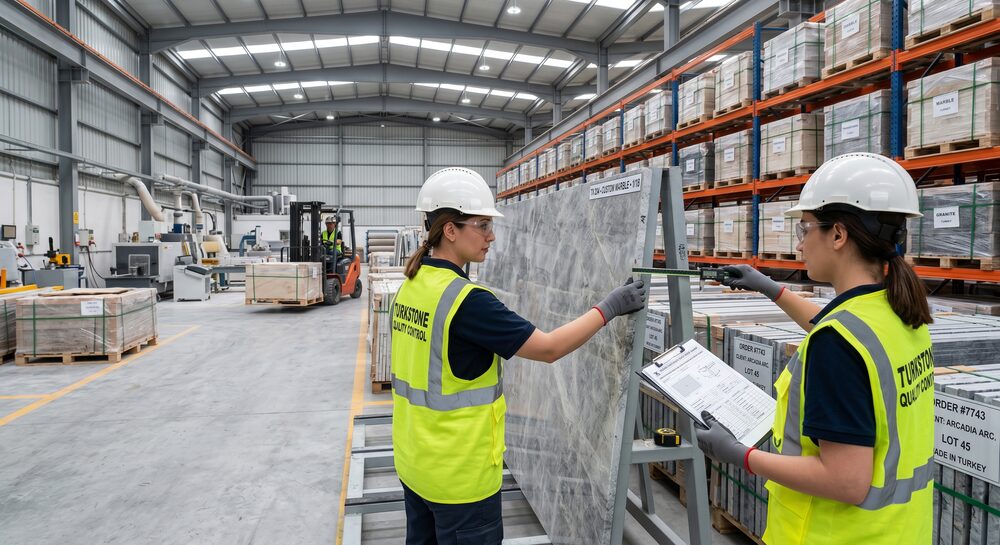
Request certificates at spec stage, not at submittal. Send us the stones on your board and the application. We pull the current lot certificates from the quarry and return them with the sample — so the number in your schedule is the number in the crate.
Governing specification
The trade name doesn't govern. The petrography does.
Half the stones sold as “marble” are geologically something else, and the specification follows the geology, not the marketing. Here is how the four ZARHA families map to ASTM specification standards.
Catalogue family
Usually classified as
Governing specification
Notes
Whites
Calcitic marble
ASTM C503, Class I
Carrara, Calacatta, Volakas, Thassos and the Turkish whites are calcite marbles.
Beige
Calcitic marble; one travertine
ASTM C503 / C1527
Travertine is a separate specification with materially different limits — see below.
Black & brown
Calcitic marble; occasionally granite
ASTM C503 / C615
Emperador, Marquina and Portoro are marbles. A stone sold as “black granite” is specified to C615.
Onyx & exotics
Onyx, quartzite, serpentine
C616 / C1526 / none
Quartzites go to C616 Class III. Green “marbles” are serpentines, C1526. Onyx has no ASTM specification.
Onyx is the honest exception. ASTM publishes no specification for onyx. It is a banded calcite — soft, often fissured, frequently resin-backed and mesh-reinforced before it leaves the factory. We test onyx against C503 and report the result as measured, but a slab that fails C503 is not automatically unsuitable: onyx is specified for backlit and vertical decorative work where flexural strength and abrasion are handled by the assembly, not the stone. We will tell you which is which before you draw it into a floor.
The specification standard for any given lot is stated on its test certificate. Where a stone's classification is uncertain, we commission a petrographic examination (ASTM C1721) rather than guess.
ASTM required minimums
What the standard actually requires.
These are the published minimum values in the ASTM specifications themselves — the pass/fail line. They are not ZARHA figures and not typical values; a good slab usually clears them comfortably.
Heavy commercial foot traffic: ask for Ha 12, not 10. C503 sets the marble minimum at 10, but the standard itself recommends a minimum abrasion hardness of 12.0 for heavy commercial floors. A lobby is not a powder room. Specify the higher number and we will pull stones that meet it.
Values as published in ASTM C503/C503M Table 1 (marble), ASTM C615/C615M (granite), and ASTM C616/C616M Classification III (quartzite). ASTM also notes that abrasion-hardness testing has known limitations because abrasive formulations have changed since the method was established.
Guideline values — not ASTM minimums
Travertine and serpentine, labelled as what they are.
The figures below are historical guideline data published by the Natural Stone Institute, not the requirement tables in ASTM C1527 and C1526. We separate them because a specifier is entitled to know which is which.
Property
Travertine · guideline
Serpentine · guideline
Test method
Absorption by weight, max
2.5 %
0.20 % exterior 0.60 % interior
ASTM C97
Density, min
144 lb/ft³
168 lb/ft³
ASTM C97
Compressive strength, min
5,000 psi interior 7,500 psi exterior
10,000 psi
ASTM C170
Modulus of rupture, min
700 psi
1,000 psi
ASTM C99
Flexural strength, min
500 psi
1,000 psi
ASTM C880
Abrasion resistance, min Ha
10
10
ASTM C241 / C1353
Travertine absorbs an order of magnitude more water than marble — 2.5 % against 0.20 %. That single line decides most of its detailing: filled versus unfilled, vein cut versus fleuri cut, sealed on all six faces before setting, and never a de-icing salt within reach of it. The governing specification is ASTM C1527; the required minimums are in the standard, and the certificate reports the measured values.
Source: Natural Stone Institute, Dimension Stone Design Manual — Travertine and Serpentine chapters, 2022. The NSI states explicitly that this historical data is provided as a guideline only and that recommended minimums are established by ASTM International.
Application suitability
Where each family belongs — and where it doesn't.
Judgement, not a test result. This is how we would advise on a first pass; the certificate, the finish, and the detail decide the final answer.
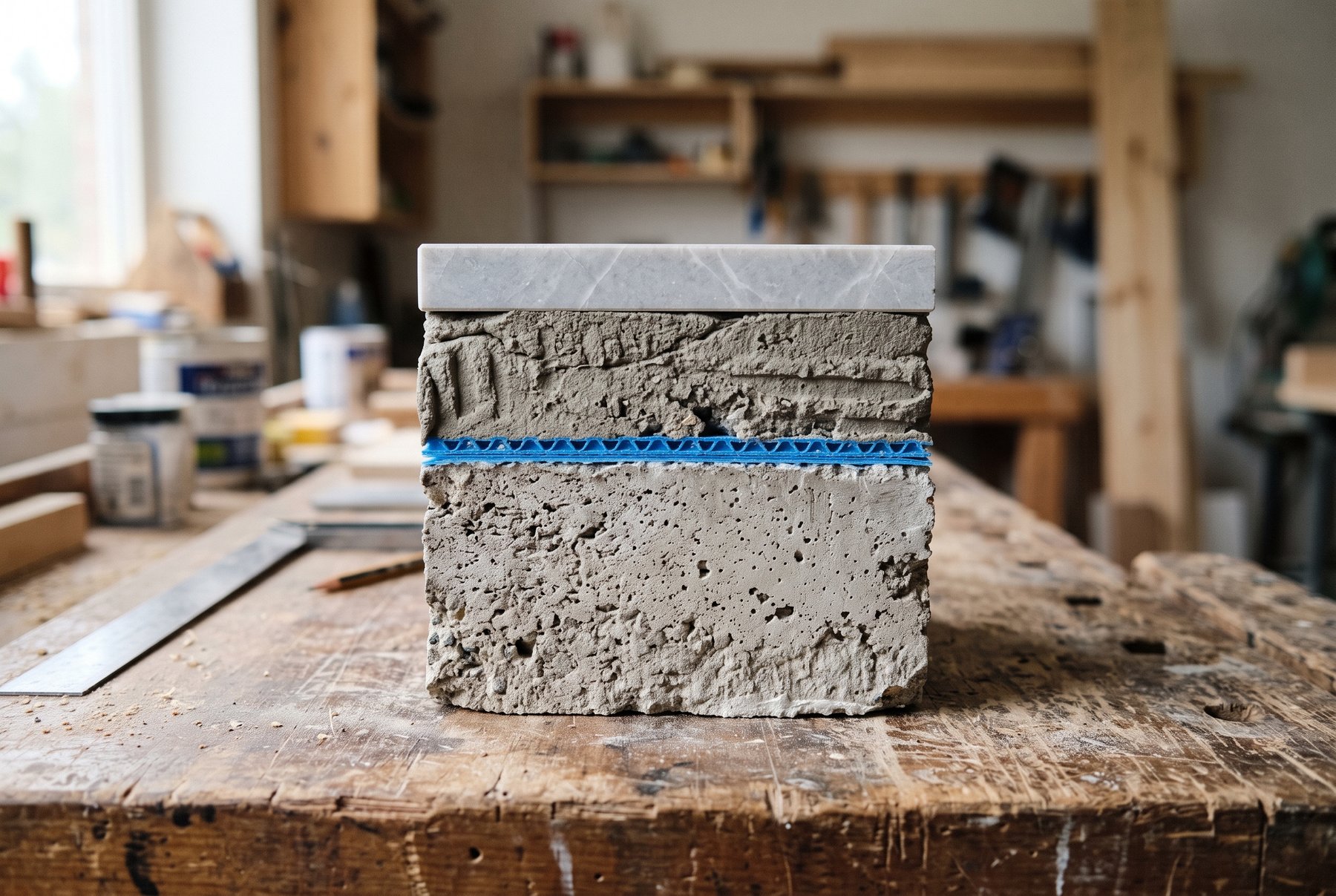
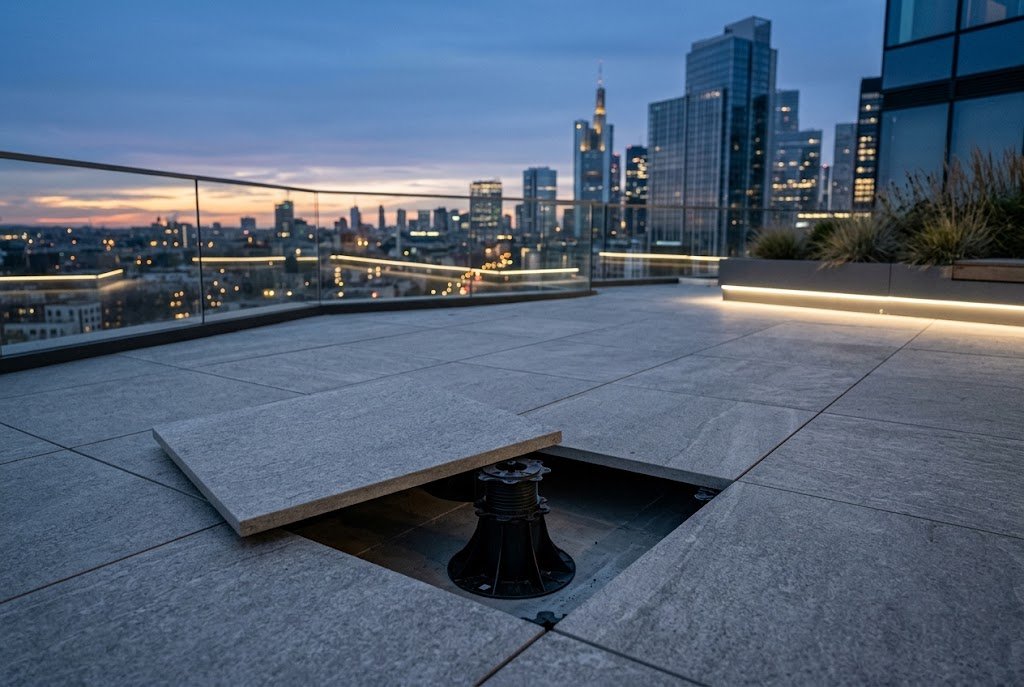
EXTERIOR PAVER ON PEDESTALS · VISUALIZATION
Family
Interior floor
Interior wall
Countertop
Wet area
Exterior paving
Ventilated facade
Marble — white, beige, black
Conditional
Suitable
Conditional
Conditional
Conditional
Conditional
Travertine
Suitable
Suitable
Conditional
Conditional
Conditional
Conditional
Serpentine — green
Suitable
Suitable
Suitable
Conditional
Not advised
Conditional
Quartzite
Suitable
Suitable
Suitable
Suitable
Suitable
Suitable
Onyx
Not advised
Suitable
Conditional
Conditional
Not advised
Not advised
Suitable standard detailing appliesConditional depends on finish, thickness, sealing or assemblyNot advised we will propose an alternative
Marble · floors
Finish decides it
Polished marble in a commercial lobby will show traffic patterns within a year. Honed or leathered wears far more gracefully, and abrasion Ha 12 is the number to specify.
Marble · countertops
Etching is not a defect
Calcite reacts with acid. Lemon, wine and descaler leave dull marks on polished marble — permanently, and no sealer prevents it. Honed hides it; clients who want zero patina should be steered to quartzite.
Serpentine · wet-set
Never in wet mortar
Green serpentines warp when set in wet cement mortar. They are installed with epoxy or a thin-set rated for moisture-sensitive stone, over a fully cured substrate. This is the single most common failure in green stone.
Exterior · cold climates
Freeze-thaw, then retest
For any exterior application in a freeze-thaw climate we specify flexural strength (C880) measured after freeze-thaw cycling, not before. De-icing salts are a separate and harsher exposure again.
Slip resistance
DCOF is a property of the finish, not of the stone.
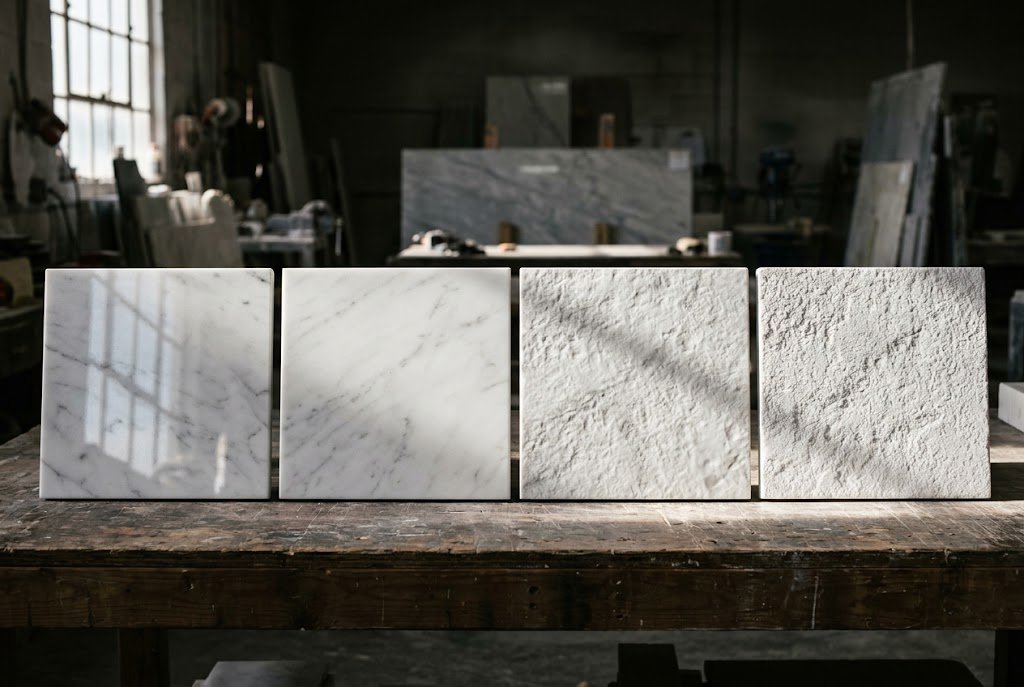
The same Carrara block yields four different DCOF values depending on how it leaves the polishing line. A DCOF figure quoted against a stone name, with no finish attached, is meaningless.
ONE STONE, FOUR FINISHES · VISUALIZATION
ANSI A326.3 product use category
Requirement
Typical application
Interior, Dry (ID)
≥ 0.42 dry DCOF
Areas expected to be dry in use — offices, retail sales floors away from entries.
Interior, Wet (IW)
≥ 0.42 wet DCOF
Areas that are intermittently wet — residential baths, kitchens, entries.
Interior, Wet Plus (IW+)
Manufacturer-declared
Continuously or heavily wet interiors — pool surrounds, locker rooms, commercial kitchens.
Exterior, Wet (EW)
Manufacturer-declared
Exterior walking surfaces exposed to rain.
Oils / Greases (O/G)
Manufacturer-declared
Surfaces subject to oil or grease contamination.
The standard says this out loud, so we will too: the measured DCOF value “shall not be the only factor in determining the appropriateness of a hard surface flooring material for a particular application.” Traffic, contaminants, maintenance regime, expected wear and the manufacturer's own recommendations all belong in the decision. A 0.42 stone maintained with the wrong cleaner is a 0.30 stone by year two.
Two findings from the Natural Stone Institute’s study of 51 stones that are worth knowing before you draw a floor. First: polished finishes do not meet the 0.42 benchmark in any stone type, as an average. If a polished floor is going into a wet-rated area, that is a conversation to have at design stage, not at submittal. Second, and counterintuitively: harder, denser materials consistently test lower than softer, less dense ones in the same finish — so a quartzite is not automatically the safer floor.
What we can supply. Wet and dry DCOF measured to A326.3 on the specific finish we are quoting — polished, honed, brushed, leathered or textured. If your project needs IW+ or EW, tell us the category at spec stage: we will test the finish rather than promise a number, and if it doesn't reach it we will propose a rougher finish on the same stone.
ANSI A326.3, Test Method for Measuring Dynamic Coefficient of Friction of Hard Surface Flooring Materials. The 2021–22 revision replaced the single 0.42 threshold with the five product use categories above. Note that A326.3 supersedes the older ASTM C1028 static-COF method, which is withdrawn and should not appear in new specifications.
Tolerances & calibration
Stone is cut to a tolerance, not to a dimension.
Every fabricated piece carries a permitted deviation. These are the industry tolerances published by the Natural Stone Institute — the values a fabricator is held to unless your specification tightens them.
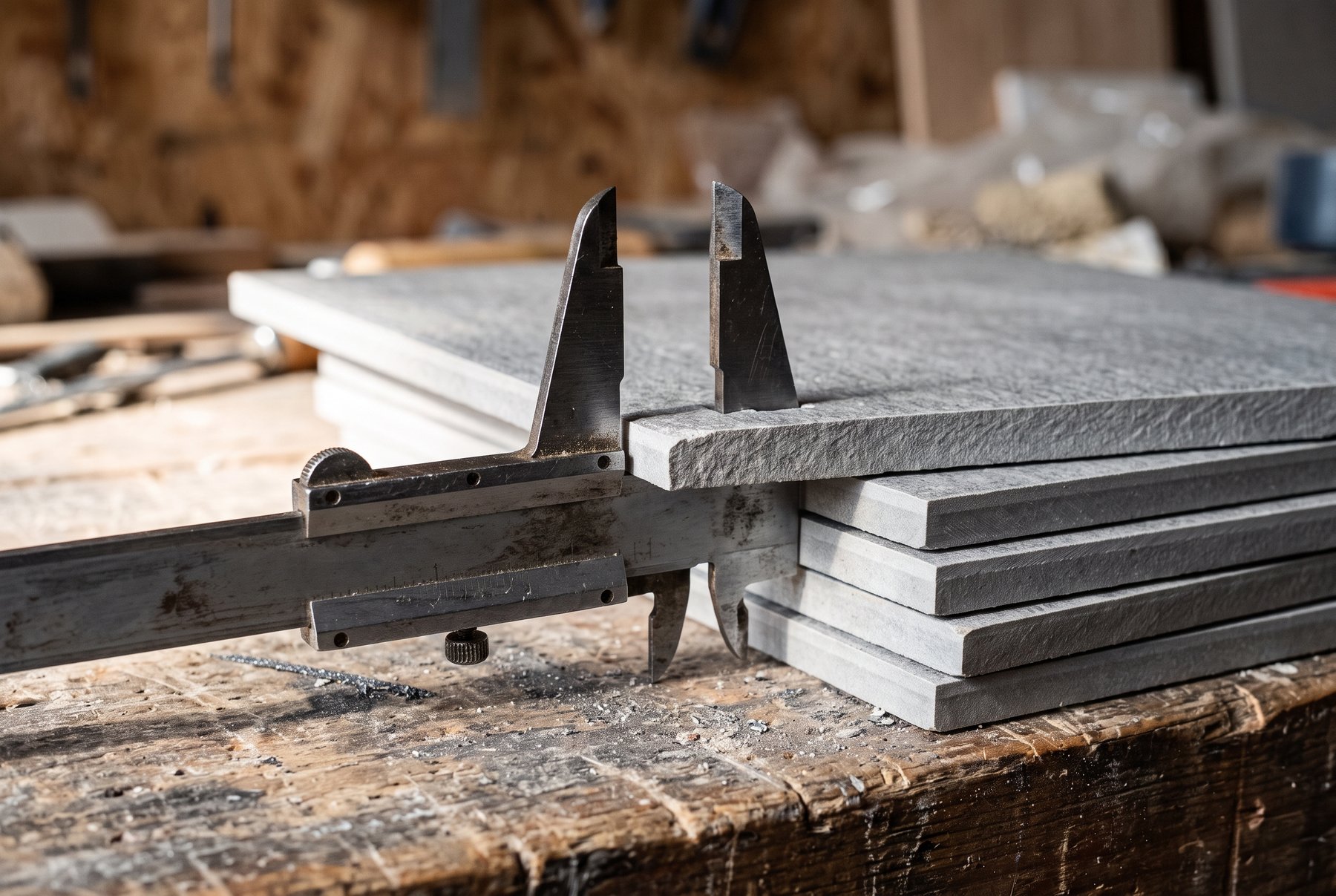
CALIBRATED TILE UNDER THE CALLIPER · VISUALIZATION
Condition
Tolerance
Applies to
Thickness — calibrated tile
± 1/32″ · ± 0.8 mm
Nominal 1/4″ to 5/8″
Thickness — slab, smooth finish
± 1/8″ · ± 3 mm
Over 5/8″ to 2″ — covers 2 cm and 3 cm slabs
Thickness — heavy slab
± 1/4″ · ± 6 mm
Over 2″
Face dimension — calibrated tile
± 1/32″ · ± 0.8 mm
Length and width
Face dimension — cut to size
± 1/16″ · ± 1.5 mm
Pieces up to 6 ft
Face dimension — large pieces
± 3/32″ to ± 1/8″
Over 6 ft; over 50 ft²
Flatness — calibrated tile
± 1/32″ in 2 ft · 0.8 mm in 600 mm
Smooth finishes
Flatness — cut to size, smooth
± 1/16″ in 4 ft · ± 1.5 mm in 1.2 m
Smooth finishes
Flatness — textured or flamed
± 3/16″ in 4 ft · ± 5 mm in 1.2 m
Textured finishes
Lippage — smooth calibrated tile
1/32″ · 0.8 mm
Installed condition
Lippage — flamed or textured
not to exceed 3/16″ · 5 mm
Installed condition
Read the flamed-finish line twice. A textured surface is permitted five millimetres of flatness deviation over 1.2 m and lippage up to 5 mm. That is the standard working as designed — a flamed face is not a machined face — but it is a number that surprises people on site. If your detail cannot absorb it, we specify a honed or brushed face instead and say so at quote stage.
Source: Natural Stone Institute, Dimension Stone Design Manual — Tolerances in the Dimension Stone Industry, 2022.
Range & control samples
The sample is a member of the range, not a picture of the order.
Natural stone has no shade-variation rating. The ceramic industry's V1–V4 scale is written for manufactured tile and does not apply here — so we handle range the way the stone industry actually does: with a physical control sample and a slab approval.
01
Range set, not a chip
For any order above a nominal threshold we supply a range set — light, mid and dark of the block or lot — so the client approves the spread rather than a single flattering piece.
02
Photographed slab approval
Full slabs are photographed square-on at known scale before cutting. For bookmatch and continuous-vein work, we lay out the sequence digitally and get it signed before a saw runs.
03
Single block where it matters
Where colour consistency is critical, the whole quantity is cut from one block and reserved. This constrains quantity and lead time — and it is the only real guarantee of match.
04
Reserved control sample
An approved control sample is retained by us and by you for the life of the job. It is the reference every delivery is judged against, and it is what settles a dispute.
What the catalogue image is, and is not. Every image in our catalogue is photographed from a real slab at known physical scale — the veining you see is the veining that exists, at the size it exists. Where an image shows a material in a room, the surface texture is mapped from the actual slab photograph; the scene around it is a visualization and is captioned as one. We do not generate stone textures. If a picture looks like your stone, it is because it is your stone.
Sealing & maintenance
Most stone failures are maintenance failures.
Specify the cleaning regime with the same seriousness as the stone. It is the variable most likely to be wrong on site, and the only one that keeps costing money after handover.
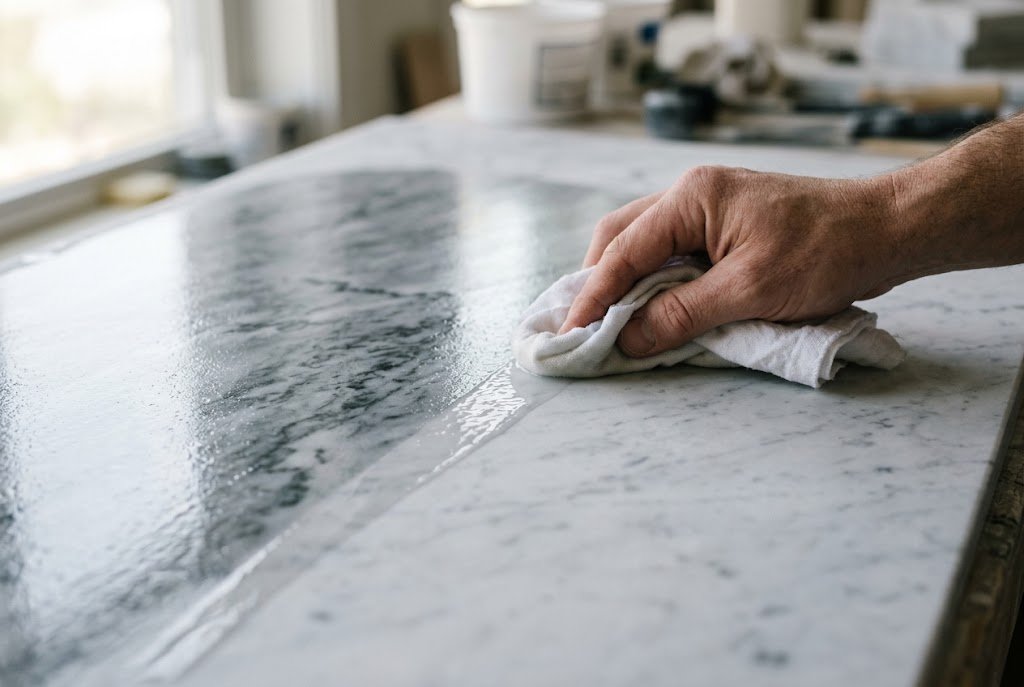
The water-drop test beats the calendar. Reapplication intervals are a starting point, not a schedule. Put a few drops of water on the surface in the busiest area: if it darkens the stone within four or five minutes, it is time to reseal. If it doesn't, leave it alone — over-sealing leaves a haze that has to be stripped.
Three rules for the facilities binder. Neutral-pH cleaner only — no vinegar, no citrus, no bleach, no generic bathroom spray on calcite stone. Walk-off matting at every exterior entry, because the grit tracked in is what abrades a floor, not the footfall. Spills blotted, never wiped, so a stain is not spread into a larger one. We supply this as a one-page owner's sheet with every stone order, in a form you can hand to a cleaning contractor.
What we will not claim. No stone is stainproof, and any supplier who says otherwise is selling something. Marble in a working kitchen will patinate. That is a property of the material, not a defect in it, and it is worth saying before the invoice rather than after. Etching is not a stain and cannot be cleaned off — it is a change in the surface, repaired by re-polishing. Solid surface, by contrast, is repairable in place: scratches and burns sand out with an abrasive pad and a matching pass.
Fire, cladding & anchorage
What we supply, and where the engineer takes over.
On a facade or a rainscreen the stone is one component of an assembly. We are responsible for the material and its test data. The anchorage design belongs to your engineer of record, and we will not pretend otherwise.
ZARHA supplies
Material, data, and fabrication to drawing
Noncombustibility documentation — natural stone is an inorganic, noncombustible material; ASTM E136 or ASTM E84 reports supplied where the authority having jurisdiction asks
Flexural strength to ASTM C880, including after freeze-thaw cycling where the climate requires it
Individual anchorage strength testing to ASTM C1354, on the actual stone and the actual anchor
Kerfs, undercut holes and dowel pockets cut to the anchor manufacturer's drawing
Mock-up panels for ASTM C1201 assembly testing where specified
Your team retains
Design, engineering, and approval
Anchor selection and layout — ASTM C1242 is the design guide, not a substitute for engineering
Wind and seismic load determination per ASCE 7 and the governing building code
Panel thickness and safety factor, set by the engineer against the tested flexural strength
Movement joints, deflection limits and interface with the backup structure
Stamped submittals and the AHJ relationship
One caveat that gets missed on fire. Stone itself is noncombustible — but many thin, fragile or fissured slabs, onyx above all, leave the factory with a resin or epoxy-and-mesh backing. That backing is an organic material, and it can change how the assembly is classified. If a fire rating is in play, tell us at spec stage: we will confirm whether the lot is backed, and supply an unbacked material or the backing's own test data.
Silica, Prop 65 & California
The rules changed this year. Natural stone is on the right side of them.
California now regulates stone fabrication more strictly than any other state, and the regulation is aimed squarely at engineered stone. It matters to anyone specifying a surface in California — and it changes what a slab supplier is allowed to do.
Material
Crystalline silica content, typical
Regulatory position
Marble
under 10 %
Lowest-silica surfacing material in common use.
Travertine, onyx, serpentine
low — calcite and silicate based
Comparable to marble; confirm per lot.
Granite
30–45 %
Wet methods required for fabrication.
Quartzite
high — predominantly quartz
Treat as a high-silica natural stone; wet methods, full controls.
Engineered / artificial stone
over 90 %
The specific target of California's STOP Act.
In force now
Dry cutting banned
From 1 January 2026, wet suppression is mandatory for cutting, drilling, grinding, polishing, abrading and chiselling — and for cleaning up the dust afterwards.
1 July 2026
Training & attestation
Employees performing high-exposure tasks require training, with annual written attestation filed with state occupational safety officials.
1 January 2027
Certification process
The state's three-year shop certification application process must be in place.
1 July 2027
Suppliers are bound too
Shop certification becomes mandatory — and slab suppliers are barred from selling to uncertified fabrication shops. That includes us.
What this means for a California project. From July 2027 we can only ship slabs to a certified fabricator, so the fabricator's certification becomes part of the procurement conversation rather than an afterthought. If you are specifying now for a 2027 handover, name the fabricator early and we will confirm their status before the order is placed. If you don't have one, we will source from shops we have already verified.
Proposition 65. Crystalline silica — airborne particles of respirable size — is listed under California Proposition 65. Cutting, grinding, drilling or polishing natural stone can generate it. Material shipped into California carries the required warning, and a Safety Data Sheet accompanies every stone order regardless of destination. The exposure risk is a fabrication and installation risk, not a risk of the installed surface in use.
Sources: California SB 20 (the STOP Act) as reported by Stone World; California Office of Environmental Health Hazard Assessment Proposition 65 chemical list. Silica content figures are typical ranges for the material class, not lot-specific assays.
Commercial terms
The questions a specifier asks on the second call.
Nothing here is a standard. It is our policy, stated plainly so it can be checked against your contract before anyone signs.
Term
Position
Why
Attic stock
5 % for standard floor and wall areas; 10 % for bookmatch, continuous vein and cut-to-size work — cut from the same block and crated separately.
A replacement piece from a different block will not match. Attic stock is the only real repair strategy for natural stone.
Reserve block
Where a project cannot tolerate variation, the block is purchased and held rather than the finished quantity.
Protects future phases and repairs against the block being sold on.
Transit damage
Inspect on arrival, note damage on the delivery receipt, and notify us within five business days with photographs of the crate and the piece.
Carrier claims have short windows. Photographs of an unopened damaged crate are what make a claim succeed.
Warranty
Twelve months from delivery against fabrication defects — dimension, finish, and cutting to approved drawings. Natural characteristics of the stone are not defects.
Veining, fissures, pitting, colour range and travertine voids are the material, not faults in it. The control sample is the reference.
Importer of record
On DDP terms ZARHA is the importer of record and duty is in the quoted number. On FOB or EXW the buyer imports and we supply the documentation.
Stated on the quote either way, so the landed cost is never a surprise at the port.
Documentation supplied
Test certificates, Safety Data Sheet, care and maintenance sheet, packing list, certificate of origin, and HTS classification on the commercial invoice.
Everything a submittal package and a customs broker need, in one set.
Limits
What we don't claim.
A technical page is only worth reading if it says what it can't do. These are ours.
We don't publish typical values. No absorption figure, no strength figure, no DCOF number appears against a stone name on this site. The specification's minimum is published; your lot's measured value comes on the certificate.
We don't rate shade variation. There is no V1–V4 for natural stone. We supply a range set and an approved control sample instead, and the order is judged against that.
We don't engineer facades. We supply the stone, the test data and the fabrication. Anchor design, load calculation and stamped submittals belong to your engineer of record.
We don't guarantee a polished floor will pass a wet DCOF category. Industry testing says polished stone does not reach 0.42 as an average in any stone type. We will test the finish and tell you the answer, not promise it in advance.
We don't treat natural characteristics as defects. Fissures, pitting, glass seams, colour movement and travertine voids are properties of the material. What we do guarantee is that you saw them before you approved it.
We don't generate stone imagery. Every texture in the catalogue is photographed from a real slab at known physical scale. Where a scene around it is simulated, the image says so on its own caption.
Questions
Stone, answered.
Can I get test certificates before I specify?+
Yes, and you should. Send us the stones on your board and the application. We pull the current lot certificates from the quarry and return them with the samples, so the numbers in your schedule match the material that will actually arrive. There is no charge and no commitment.
My spec calls for a DCOF of 0.42. Which stones meet it?+
That depends entirely on the finish, not the stone. Polished surfaces generally do not reach 0.42 in any stone type. Honed, brushed, leathered and textured finishes usually do, with coarser honing performing better. Tell us the ANSI A326.3 category — Interior Dry, Interior Wet, Interior Wet Plus, Exterior Wet, or Oils/Greases — and we will test the finish we are quoting and report the measured value.
Is marble suitable for a commercial lobby floor?+
Often, with two conditions. Specify abrasion hardness Ha 12 rather than the C503 minimum of 10, and specify a honed or leathered finish rather than polished — polished marble shows traffic patterns in a lobby within a year, and it will not meet a wet DCOF category. Walk-off matting at the entries does more for the floor's life than any sealer.
Why is green marble treated differently?+
Because it isn't marble. Green stones sold as marble are serpentines, governed by ASTM C1526, and they warp when set in wet cement mortar. They must be installed with epoxy or a thin-set rated for moisture-sensitive stone, over a fully cured substrate. This is the most common failure mode in green stone and it is entirely avoidable.
Can onyx go on a floor?+
We advise against it. Onyx has no ASTM specification, is soft and frequently fissured, and usually ships resin-backed and mesh-reinforced. It is a superb backlit and vertical decorative material and a poor floor. If a client is set on it, we will say so in writing and propose a quartzite or a marble that reads similarly.
What does California's silica law mean for my project?+
It targets engineered stone, which is over 90 % crystalline silica; marble is under 10 %. Practically, dry cutting has been banned since January 2026, and from July 2027 slab suppliers may only sell to certified fabrication shops. If you are specifying now for a 2027 handover, name the fabricator early so we can confirm their certification before the order is placed.
How much extra should I order?+
Five per cent for standard floor and wall areas, ten for bookmatch, continuous vein and cut-to-size work — cut from the same block and crated separately as attic stock. A replacement piece cut from a different block later will not match, so this is the only real repair strategy for natural stone.
Do you supply mock-ups?+
Yes — range sets, full-slab photography at known scale before cutting, digital bookmatch layouts for approval, and physical mock-up panels for ASTM C1201 assembly testing where a facade specification requires them.
The catalogue
Sixty-four stones, photographed from real slabs at real scale.
Every stone on this page is in the catalogue with its slab face, manufacturer photography, and finish and edge options. Pick the material first; we will bring the certificate.